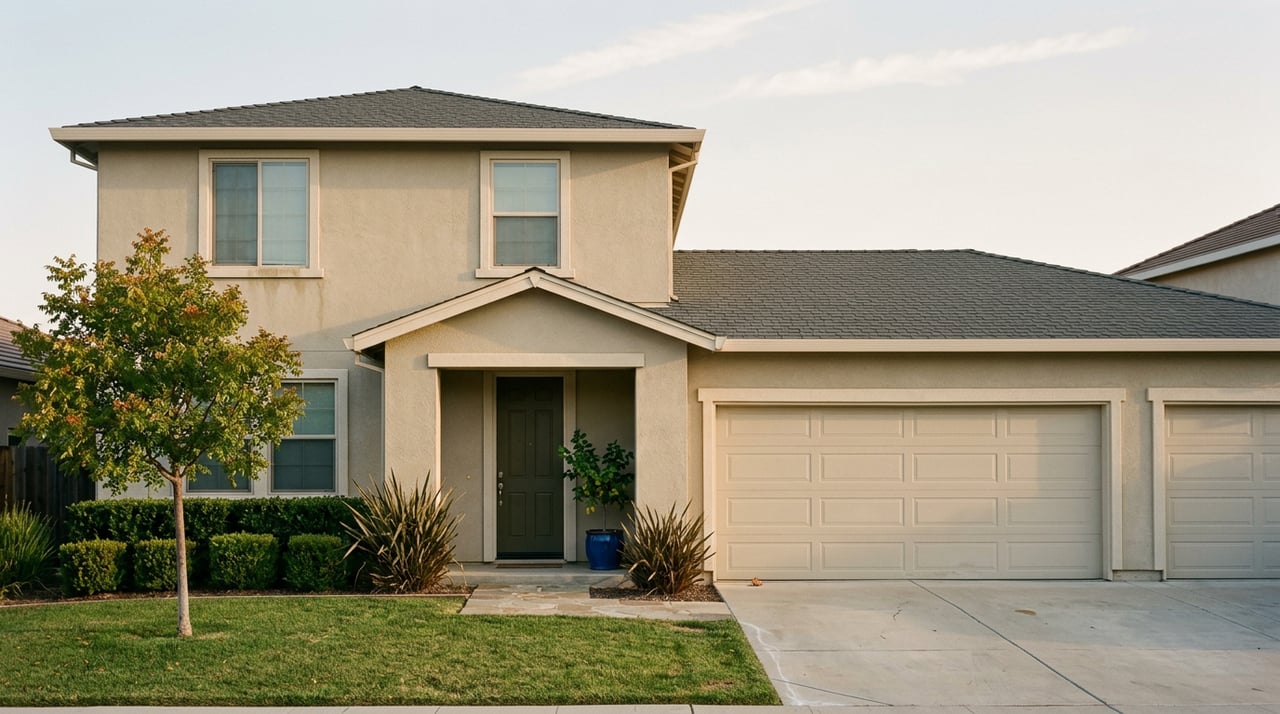
Say you've narrowed your search to two listings. Same city, same school boundary, same square footage, priced within a few thousand dollars of each other. You run the numbers on a mortgage calculator and the payments look nearly identical. Then, a week or two into escrow, a document called a Notice of Special Tax shows up in your inbox, and one of those two homes suddenly costs more each month than the other. Nothing about the house changed. What changed is which side of an invisible line your parcel sits on.
That line has a name in Placer County: the Community Facilities District, or CFD, better known by its 1982 nickname, Mello-Roos. It is the single biggest reason two homes with the same price tag in Rocklin or Roseville can carry very different real costs, and it almost never shows up in the number everyone quotes when they talk about the market.
The number everyone quotes isn't the number that matters
As of July 22, 2026, the median listing price in Rocklin sat at $697,130, working out to roughly $387 a square foot. Roseville's median sale price ran cooler, at $635,000 over the three months ending May 2026. Those numbers get repeated in every market update, and they're accurate as far as they go. What they don't tell you is whether the home comes with an active bond assessment, one that rides on top of the standard property tax rate and shows up as its own line item on the county tax bill.
This isn't a Rocklin-versus-Roseville story. It's a parcel-versus-parcel story. Two homes in the same zip code, sometimes on the same street, can carry different tax burdens depending on when the surrounding infrastructure was financed and by whom.
Eleven districts, one city
The City of Rocklin currently maintains eleven Mello-Roos Community Facilities Districts, each one tied to a specific pocket of development. CFD No. 1 covers Stanford Ranch, Whitney Oaks, and Sunset-West, among other neighborhoods, with the tax amount on any given parcel depending on the type of construction on it.
Whitney Ranch runs on its own district, CFD No. 10, and the paper trail on this one is unusually specific. According to Municipal Securities Rulemaking Board records, the bonds were issued in 2005 under a $60 million authorization, covering roughly 825 acres in the first phase, with the underlying large-lot subdivision spanning about 1,296 acres and entitled for up to 3,129 single-family units. Whitney Ranch was also annexed into Rocklin Unified School District's own CFD No. 3, meaning a home there can carry both a city-level infrastructure assessment and a separate school district assessment.
None of this means Whitney Ranch is a bad place to buy. It means a 2005-vintage bond is roughly two decades into a payoff schedule that LegalClarity describes as usually lasting 20 to 40 years, while a resale in an older, already-annexed pocket of Stanford Ranch might be carrying a smaller, more predictable assessment, or none at all if that particular parcel sat outside the district's boundary from the start.
Roseville's newer frontier carries its own math
Roseville's own finance department lists its active districts by name: Creekview CFD 2, Crocker Ranch CFD 2, Fiddyment CFD 2, Highland Reserve North CFD 2, HP Campus Oaks CFD 2, the Infill Services District CFD 4, and Villages at Sierra Vista CFD 1. Each of those funded something specific, roads, sewer lines, parks, fire service, in a part of the city that was raw land when Proposition 13 made it hard for cities to finance that kind of buildout any other way.
The practical pattern locally is consistent with what shows up across Placer County generally: newer construction on the western edge of both cities tends to carry higher ongoing assessments than resale homes in established, already-built-out neighborhoods. Those costs never touch the sale price and never show up on a portal's estimate.
The clause that makes this compound on its own schedule
Here's the part that catches people off guard even after they've found the number. A standard Prop 13 property tax bill is tied to the home's assessed value. A Mello-Roos assessment doesn't work that way. Rocklin's own guidance on its districts confirms the ceiling is a 2 to 4 percent annual increase written into the original bond formation, independent of what the home is worth in any given year. Homeowners are never charged above that ceiling, but they also don't need the market to move for the number on their bill to climb. It escalates because the bond agreement says it does, not because your home appreciated.
That's the mechanism most buyers miss. Two identical monthly payments today can diverge steadily over a decade, and the divergence has nothing to do with either home's resale value.
When you find out, and what you can still do about it
California law is specific about how and when a buyer learns this. Sellers of a property inside a CFD are required to provide a written Notice of Special Tax before the purchase contract is signed, not after, under Government Code Section 53341.5. That notice has to spell out the district's name, the current annual tax, the maximum tax that can be levied, the escalation rate, and the date the assessment is set to expire, per Civil Code Section 1102.6b.
If that notice arrives late, after you've already signed, you're not stuck. Civil Code Section 1102.3 gives you three days after in-person delivery, or five days after it's mailed, to cancel the contract in writing with no penalty and no forfeited deposit. It's a real protection, but discovering an annual assessment during a three-day rescission window is a stressful way to find out, and it's avoidable if the disclosure gets pulled early.
The clock nobody mentions until it matters
One more detail worth knowing before you're ever in a position to need it. The accelerated foreclosure rules for Mello-Roos are genuinely faster than standard property tax enforcement. According to the AV City FAQ, a district can begin foreclosure proceedings 150 to 180 days after a special tax payment goes delinquent. A county collecting ordinary delinquent property taxes generally has to wait five years before foreclosing. That gap exists because these are bond obligations, and bondholders need a shorter runway than a general fund does.
This is not a reason to avoid a CFD home. It's a reason to know your exact number and keep the payment current.
Before you write the offer
A few steps take the guesswork out of this entirely:
- Pull the current property tax bill from the Placer County Property Tax Division. Any CFD assessment appears as its own line item, separate from the base rate.
- For new construction, request the builder's CFD disclosure document before you sign anything. It's required by law and will list every district the parcel sits in.
- If you want the exact current levy on a specific parcel in Rocklin, the city's Mello-Roos FAQ page lists a direct contact for the district's administrator, Muni Financial, who can confirm the current tax, the expiration date, and whether prepayment is an option.
- Ask your lender whether they factor the assessment into your debt-to-income calculation. Some do, particularly on jumbo loans, and it can shift what you actually qualify for.
- Compare the total monthly number, mortgage plus base tax plus any CFD assessment, not just the sale price, before you decide one listing is cheaper than another.
A few questions worth asking directly
Does Mello-Roos ever go away? Most assessments are tied to a bond with a set term, usually 20 to 40 years from formation. Once the bond is paid off, that portion of the tax disappears. Some districts also levy a separate services charge for things like fire protection.
Can I prepay it? Sometimes. If the underlying obligation is bond-financed, some districts allow a lump-sum payoff. Rocklin directs those questions to Muni Financial directly, since the payoff amount depends on the specific parcel and remaining term.
Will an online home value estimate include this? No. Automated valuation tools price the structure and the land. They don't read the parcel's CFD status, which is exactly why the number on a portal and the number on your actual monthly bill can diverge more in Rocklin and Roseville than in an older, fully built-out neighborhood.
The house doesn't change. The bill underneath it can, and it's worth knowing which one you're signing up for before you're three days into a rescission clock. If you're comparing homes in Rocklin, Roseville, or anywhere else in the foothills and want someone to pull the actual numbers before you write an offer, Talk to Bill First.
This article is general information, not legal, tax or financial advice. Consult a qualified professional about your situation.