Every Nevada City purchase contract has a page most buyers initial without reading past the first line. It's the county-mandated mining disclosure, and it reads like a warning label written by a committee: something about abandoned shafts, adits, and tunnel air holes that "have been known to collapse without warning." Buyers sign it the way they sign the smoke detector acknowledgment. It feels like paperwork.
It isn't. The paragraph exists because Nevada County sits on top of one of California's densest concentrations of 19th-century gold workings, and because at least one Nevada City-area landowner found out the hard way that this history doesn't stay buried when the mining stops. His name is Steve Elder, and his story is the clearest argument I know for reading that page twice.
A Foothills Full of Old Workings
Nevada City isn't a metaphorically historic town. It's a literally undermined one. According to EPA records, the town of roughly 3,000 residents sits above 16 major mines from its Gold Rush era, and the federal government has funded Brownfields assessment work here, collecting soil samples and prioritizing former mine sites for cleanup evaluation before they're considered safe for other uses. That's not a program built around a settled historical footnote. It's built around ground that still needed checking.
This is the context the mining disclosure is written into. The Nevada County Addendum to the Statewide Buyer and Seller Advisory tells prospective buyers plainly that any property in the Sierra Nevada foothills may have past or current mining activity, that many shafts and tunnels were never sealed or mapped, and that mining has been known to affect both soil and groundwater. The county has required this specific language since 1990, under Ordinance 1627, and updated it again in 2021 under Ordinance 2499. That's not boilerplate lawyers added for cover. It's a disclosure the county has actively maintained for over three decades because the underlying risk hasn't gone anywhere.
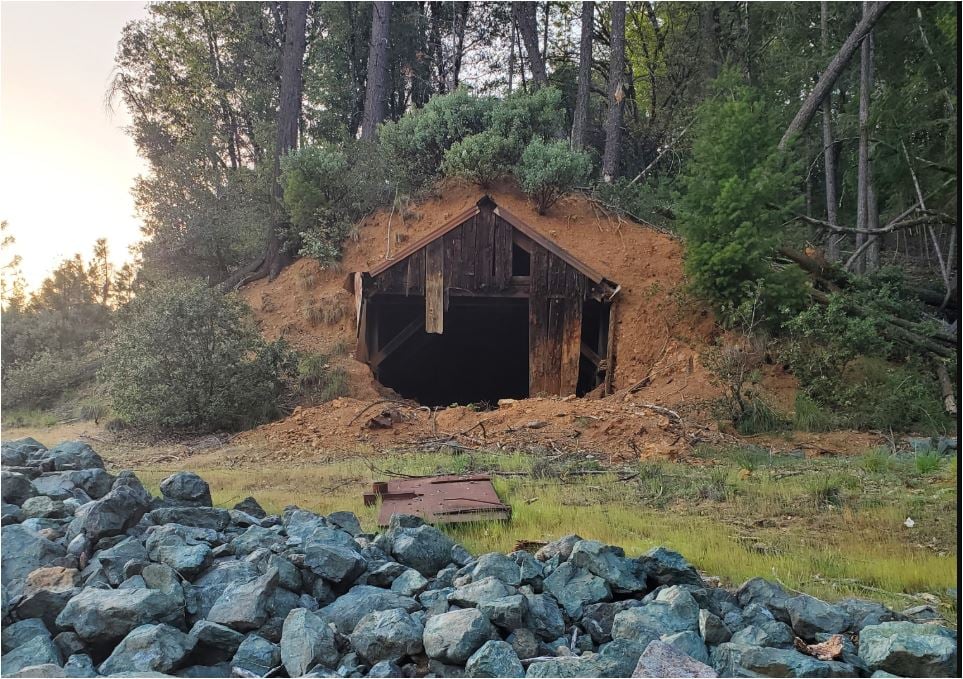
Photo Credit: https://lavacapmine.com/
The Property That Turned the Line Into a Lawsuit
Here's what that risk looks like when it stops being theoretical.
In 1988, Steve Elder, a Southern California real estate developer, bought 486 acres on Banner Mountain just east of Nevada City for $800,000. He and a partner carved off part of it into 29 luxury residential lots, a subdivision now known as Banner Mountain Woodlands, and went their separate ways. Elder kept 100 of the original acres for himself, land that included the old Lava Cap Mine. "I fell in love with the mine," he later said. He had no idea, during escrow, that he was buying a liability that predated his birth.
Various operators had worked the Lava Cap and the adjoining Banner Mine, connected underground by a 5,000-foot horizontal passage, from 1861 until 1943. On New Year's Eve 1996, heavy rains overwhelmed a decades-old tailings dam on the property. It burst, sending more than 10,000 cubic yards of arsenic-laden waste rock into Little Clipper Creek, nearly 20 years after a state report had already flagged the dam as weak. The site became a federal Superfund cleanup. The U.S. Department of Justice moved to recover roughly $20 million in cleanup costs, and Elder, who never operated a single day of mining on that land, was named as a responsible party. Separately, the state pursued Newmont Mining Corporation for $3 million tied to the same site. An estimated 47,000 abandoned mines are scattered across California, according to a 2008 Sierra Fund report, and Lava Cap is the one that shows what happens when the paperwork catches up with the geology.
Liability Runs With the Title, Not With the Miner
This is the part most buyers never connect to the disclosure they signed. Environmental cleanup liability in cases like this doesn't attach to whoever caused the contamination. It attaches to whoever holds title when the problem surfaces. Elder didn't dig the shafts, build the dam, or dump a single load of tailings. He bought land in 1988 and inherited exposure from mining that ended in 1943, decades before he was born.
That's the actual function of the mining disclosure. It isn't telling you a mine might collapse under your driveway, though that's the part that reads scariest. It's telling you that ownership of foothill property in this county can come with inherited liability that has nothing to do with fault and everything to do with the chain of title. Reading it as a formality misses what it's actually flagging.
What Actually Gets Checked, and by Whom
Buyers often assume one of three protections in a purchase covers this. Usually none of them do on their own.
Protection | What it typically covers | What it typically misses |
|---|---|---|
Mining disclosure addendum | Notice that the region has mining history and unmapped workings | Whether this specific parcel has documented workings or contamination |
Standard home inspection | Structure, roof, electrical, plumbing, HVAC | Subsurface mine workings, soil or groundwater contamination |
Title insurance | Ownership defects, liens, recorded easements | Environmental liability tied to land use history, in most standard policies |
None of these three is designed to answer the one question that actually matters: does this specific parcel have a documented mining history, and if so, what did that history leave behind. That question gets answered through a records search, not a signature on a disclosure form.
The Second Disclosure Riding Along With It
The mining addendum rarely travels alone. California requires a separate Fire Hardening and Defensible Space Disclosure in high fire risk areas, which covers most of unincorporated Nevada County and the wildland edges close to town. It spells out two zones around a structure: Zone 1 runs from the foundation out to 30 feet, and Zone 2 extends from there to 100 feet, each with its own maintenance standard. For Nevada City's older wood-frame homes, many built close together on narrow historic lots, this disclosure is doing a similar job to the mining one. It's naming a background risk of the terrain that a buyer from a flatter market has never had to think about.
What Actually Turns Up Inside an Old Nevada City House
The mining and fire disclosures deal with the land. The house itself carries its own set of quirks that inspectors here see constantly. Local contractors who work the historic core regularly report the same handful of findings in Gold Rush and early 20th-century construction: non-standard framing dimensions that don't match modern lumber, lath and plaster walls, knob-and-tube wiring still live behind the drywall, and foundation settling that wasn't caught until a remodel opened the walls. None of this makes an old Nevada City home a bad buy. It makes the inspection period the place where the real information shows up, not the disclosure paragraph itself.
Before You Initial the Page
A few questions are worth asking before you sign, regardless of which side of the transaction you're on:
- Has a mining claims or historical use search been run on this specific parcel, separate from the general county disclosure
- What does the title company's policy actually exclude when it comes to environmental conditions
- If the home sits in the Nevada City Historic District, does any planned work trigger review under the city's preservation ordinance before a permit gets pulled
- Has a general inspector flagged anything that needs a specialist, particularly around foundation, wiring, or drainage in an older structure
None of these questions are meant to talk anyone out of buying in Nevada City. They're meant to replace a signature on a form with an actual answer.
A Few Questions I Get Asked
Does the mining disclosure mean my downtown Victorian sits on an old mine? Not necessarily. It means the county requires every seller in this region to disclose that the possibility exists somewhere in the area, mapped or not. Whether it applies to a specific address is a separate question, answered by records, not by the form.
Would title insurance have protected Steve Elder? Most standard title policies are built around ownership defects and recorded liens, not environmental contamination tied to historical land use. That gap is exactly why the mining disclosure and a records search matter independently of title coverage.
Is this something homeowners insurance handles? Environmental cleanup liability and standard homeowners coverage are generally separate conversations, and coverage details vary by carrier and policy. This is worth a direct conversation with your insurance agent rather than an assumption either way.
Where This Leaves You
The mining disclosure in a Nevada City contract is one of the few pages in the whole packet that's actually trying to tell you something specific about where you're buying. Lava Cap Mine is the proof that the risk it describes isn't decorative language. It's a real mechanism, and it's one more reason a transaction here benefits from someone who reads the county's paperwork the way it was meant to be read, not the way it usually gets signed.
If you're weighing a purchase or a sale in Nevada City and want someone to walk through exactly what's showing up on your specific parcel, Segers Home Services Group is a good place to start. Talk to Bill First.
Bill Segers, CA DRE#01734838